eater's digest

ordinary pleasures : café culture

As an undergraduate, I often spent my time in between classes at coffee shops on campus.  On occasion, I made genuine attempts at academic progress, but in truth, anyone trying to work was better off in the dorms or the library.  The coffee shop, in essence, was a not-so-subtle locale to see and be seen.  There I’d sit - staring at the same page, rereading the same line - hoping that my crush-of-the-moment would happen upon me nonchalantly reading Rilke.  (As if the average undergraduate male actually cared what the heck I was reading).

But a true café - that European or Europhilic wonder of the world - resembles neither the collegiate coffee shop (a slightly less commercial variant of your local Starbucks) nor a silent study hall.  It has a character all its own - charmingly unchanging despite generations of regulars, who ultimately leave it high-and-dry after an intense stint of unflinching fidelity.  It’s a quiet, yet buzzing corner of the world, best suited to the grad student, youthful researcher or urban creative - thinkers entrenched in their own ideals and interests, both incensed and mellowed by the fog of sleepless nights.

Which brings me to the subject of sustenance.  Some café creatures seem to live on black coffee alone.  Others drift towards cigarettes or café crèmes.  But my favorite cafés are those who provide a little something more to chew on (as endless hours of reading seem to have a way of cultivating oral fixations).

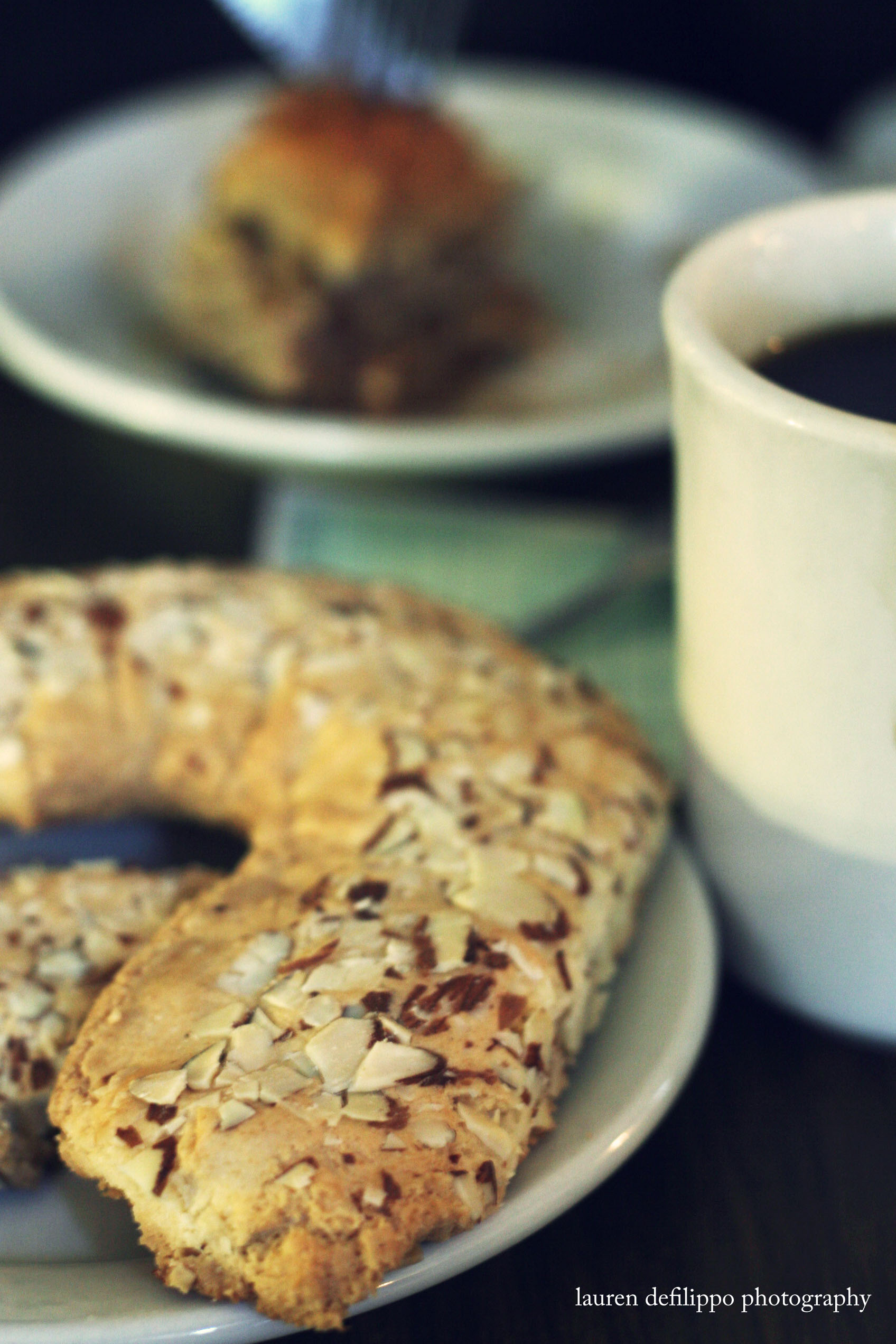
In Paris, my café of choice was the Café Maure at the Grand Mosquée de Paris.  Built in the years following World War I, La Grande Mosquée remains the only official mosque in Paris, despite the significant growth of the capital’s Muslim population.  The mosque itself is typically closed to all but the faithful, but on the corner of Rue Daubeton and Rue Geoffroy-Saint-Hilaire, a Moorish archway invites the curious in - to sip sweet mint tea, smoke hookah or nibble on honey-laden pastries under the shade of fig trees. There I would spend many an afternoon, induling in Kaab el Ghazal (half-moon pastries perfumed with orange flower water) and reading French philosophy).

Back in New York, there’s no shortage of cafés worth frequenting in the city, but unlike Paris, those worth lingering in are a bit harder to come by.  Morningside Heights' Hungarian Pastry Shop is one of these rare gems, located just outside the thumping heart of Columbia’s main campus.
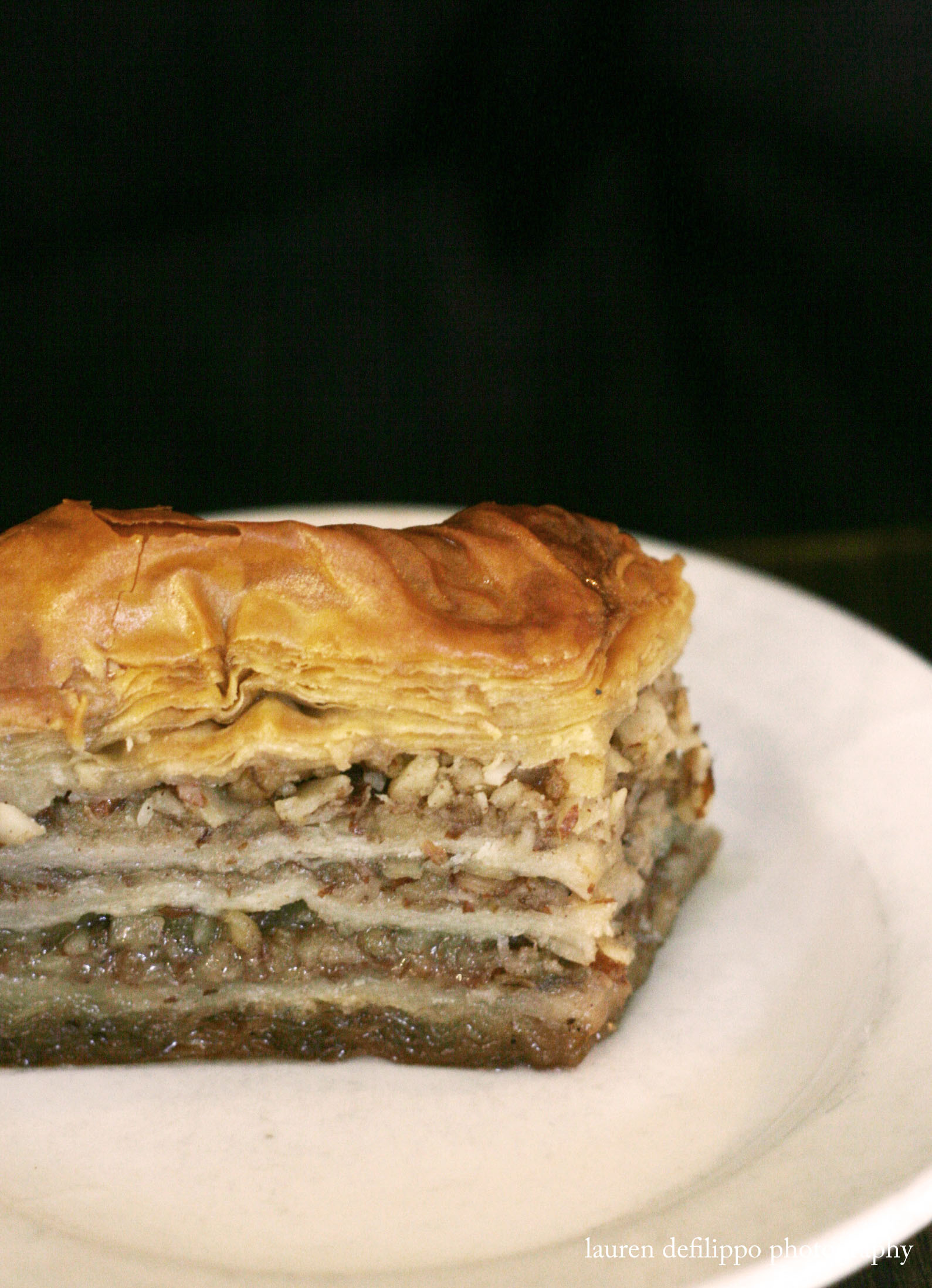
The leaner (and thriftier) among us will rave about Hungarian's free refills, but my indulgence of choice is their baklava – honey soaked and nutty as the day is long, somehow simultaneously flaky and densely chewy. (When I worked at Columbia, the walk home past Hungarian was treacherous.  The only thing that saved me from poverty-by-pastry was the fact that the desserts are not quite viewable from the window).  And with an ambiance fitting of an old Woody Allen film (or Love Story, if the protagonists had attended Columbia), there’s enough 1970s flair to sustain the whole neighborhood’s charm.

True, it can be hard to find a seat here – but in warmer months the sculpture garden at St. John the Divine (just across the street) is an enviable extension of HP’s café culture.  At worst, if it’s too cold or crowded to stay, they’ll wrap you up a snack in an old-timey paper box with striped pastry string.  An adorable consolation prize for your efforts.

eater's digest: owen's fish camp

Relaxation (see: “beach vacation”) is not something I do well.  So when my parents requested - for the second year in a row - that we spend our Christmas break on the warmer shores of Florida, I begrudgingly acquiesced, mumbling something under my breath about strip-malls and the “dearth of culture”. But this year, my mother was out to prove me wrong, selecting Sarasota – home to the Ringling estate and museum, as well as the “Best Beach in America”.  It may have taken a few days (and some sifting through local food/travel publications) for me to settle in and truly enjoy myself, but eventually I came round – most notably, due to the literally and figuratively fresh dining scene we discovered in this beach community just south of Tampa.  (And yes, my mother is reading this, all too happy with my public declaration that she “told me so”).

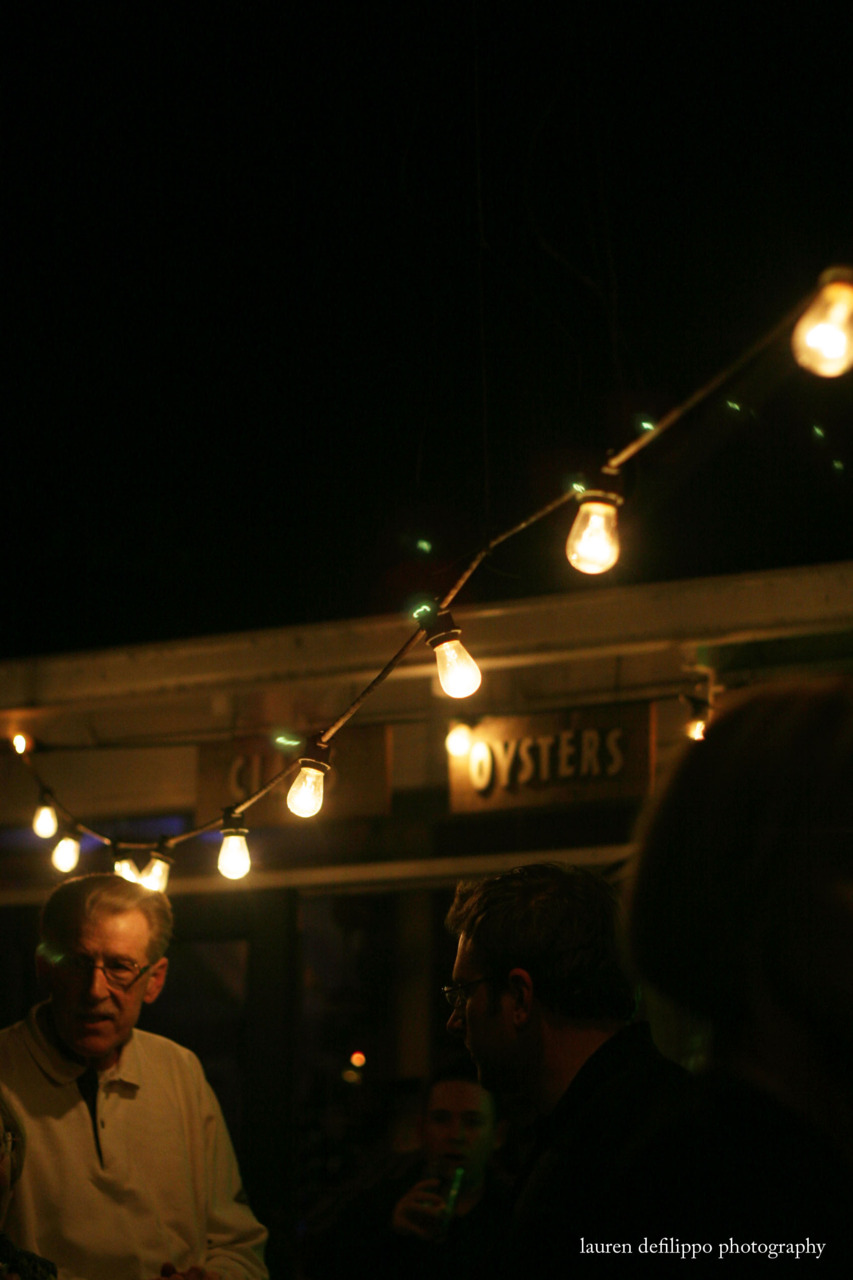
Owen’s Fish Camp sits in an eclectic corner of downtown Sarasota, under the bows of an imposing banyan tree.  Across from a remarkable antiques shop and next door to an art gallery, the vibe is decidedly “trendy bayou”, with patrons in shorts and stilettos alike.

Waiting outside Owen’s is one of the most pleasant aspects of the restaurant.  The quaintly campy outdoor patio features a number of well-curated tchotchkes, including a life-sized, under-shirted “local” in a lawn chair.  The aforementioned antiques shop and art gallery also (wisely) leave their doors open late, reinforcing the laid-back block-party vibe.

Those who choose to grab a drink will find a light-hearted wine list (selections designated as “Good”, “Decent”, or “Cheap”), a solid beer selection and respectable cocktails.  That was where I also first spotted the absolutely delectable-looking pecan pie (more on that later).

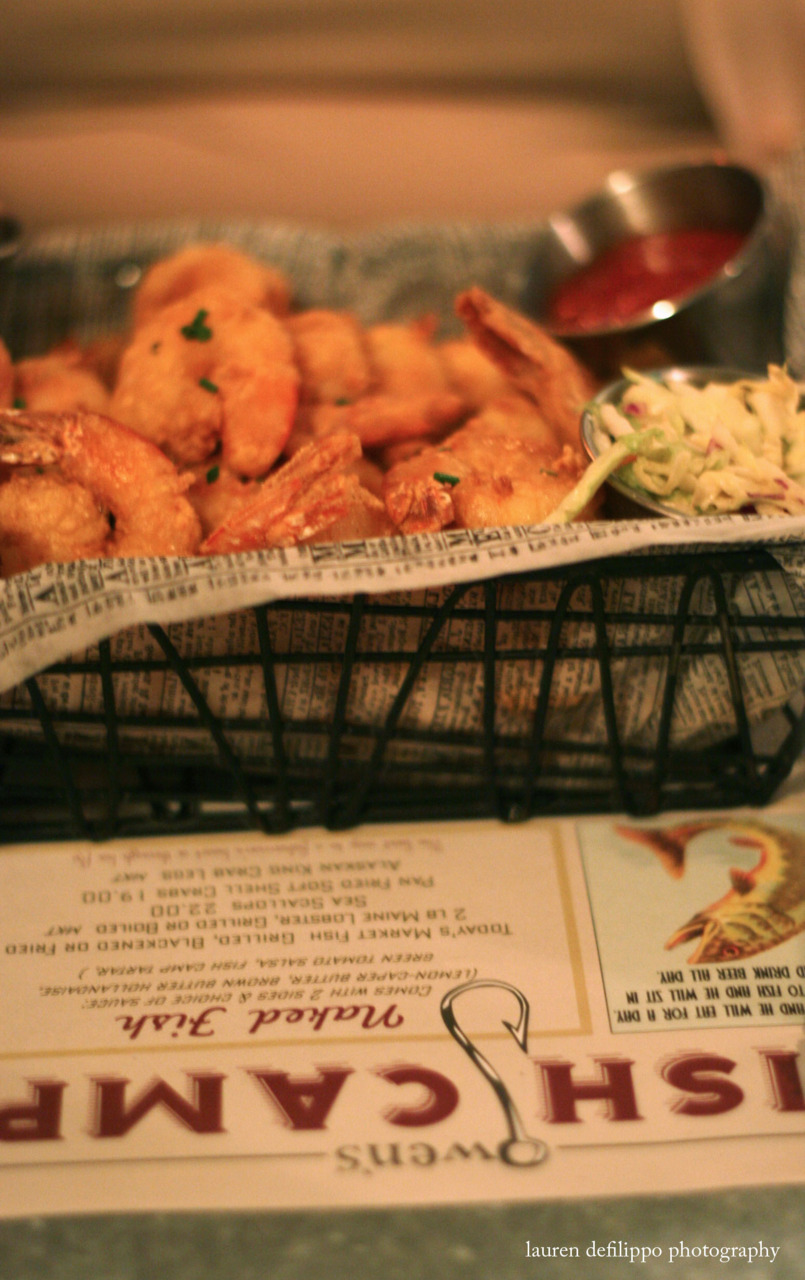
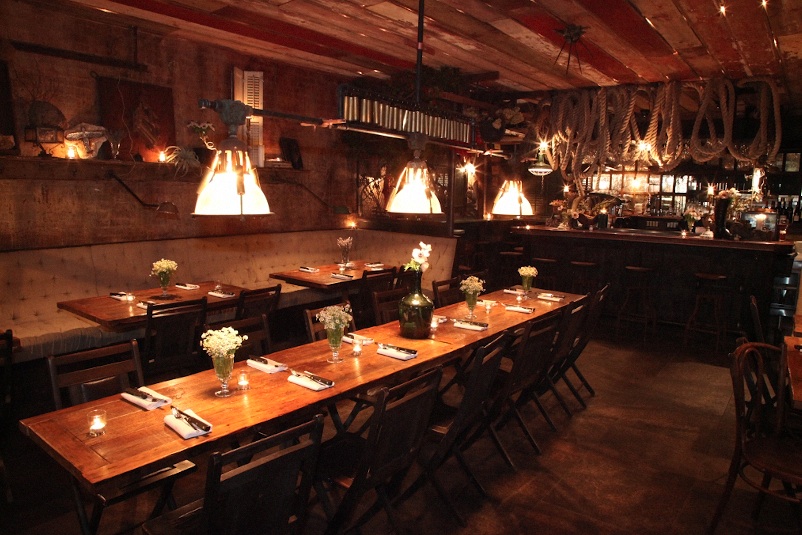
I was seated with my family in the restaurant’s back room, oars hanging overhead.  Old-fashioned condiments dressed the table, and the menu was appropriately, a paper placemat.  The offerings were inspired by classic southern seafood, from cornmeal battered catfish to a softshell crab BLT.  We ordered both as entrees, as well as a shrimp basket, with a fried green tomato salad and clam chowder to start.

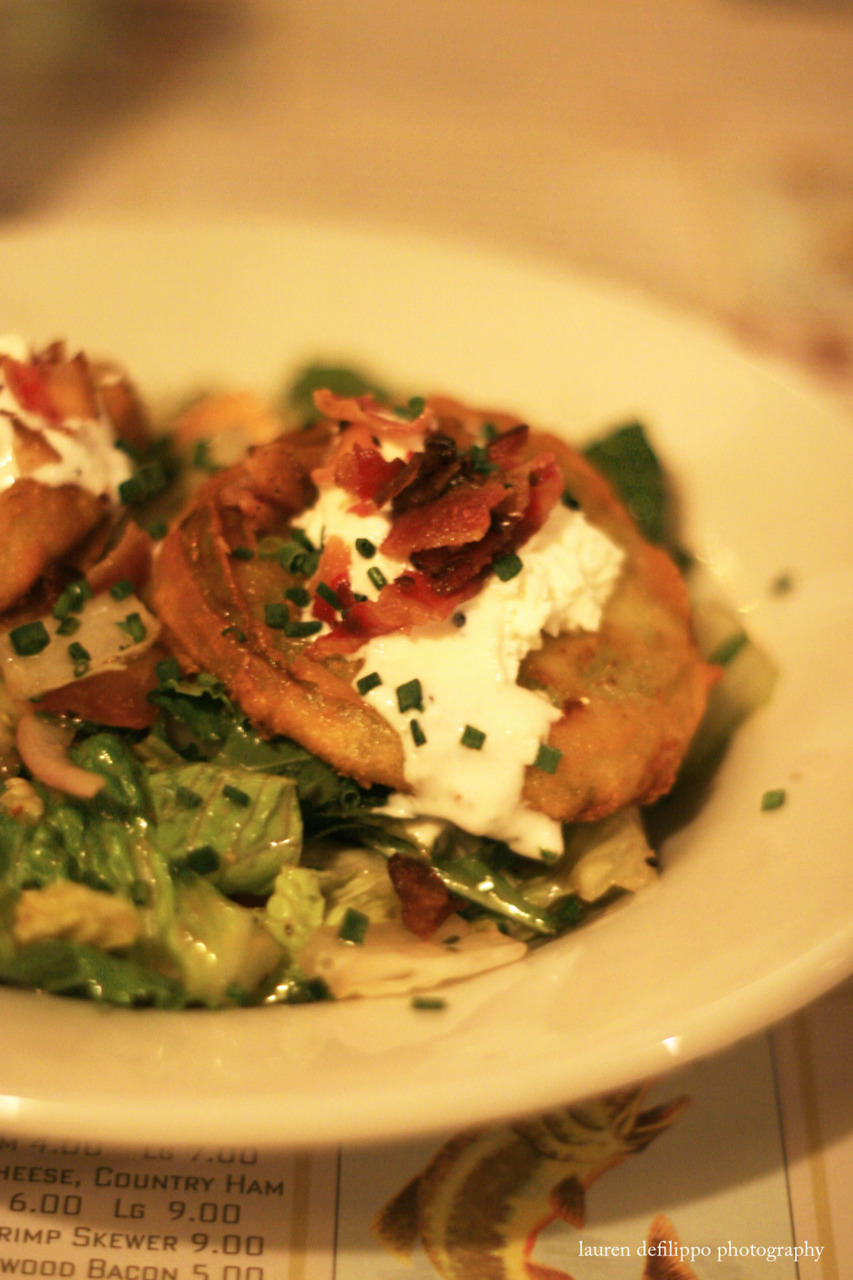
The starters were remarkable, almost the best part of the meal.  The cornmeal-crusted FGTs (fried green tomatoes) were served over arugula and romaine with chevre chaud, crisped country ham, cucumber, red onion, and an herb-buttermilk dressing.  Light, refreshing and impossible to resist – this was hands-down the best savory item we ate.  The creamy chowder was also noteworthy, with an almost lobster bisque-y flavor (enhanced by applewood bacon) and chock-full-of-clams.

Even compared with that rousing first round, our entrees proved to be excellent.  The shrimp basket arrived light and piping hot, with thin fries begging to be dressed with malt vinegar.  Crunching through the cornmeal crust, the catfish was flaky and fresh, almost shockingly moist.  And the sandwiched softshell poked out from its bun, spicy, tangy, “crabby” and undeniably indulgent.  But let’s not forget the savory sides, most especially the vinegar-y collards and robust, smoky succotash.

After all this soul-warming southern cooking, I could have easily bypassed dessert – but then again, I had already spotted the pecan pie.  We ordered this and the deep-fried blackberry pies, flaky half-moon dessert “pierogies” that sounded promising but lacked a true pie’s high fruit-to-crust ratio.  The pecan pie, however, was the very best item of the evening, a seemingly simple tart of pecans and honey, topped with homemade whipped cream.  The crust wasn’t overcooked, nor the nuts over-sweetened.  In fact, even my dessert-disdaining sister dove back in for seconds.

As we strolled out of the fish camp into the chilly (for Florida) night air, I knew this was hands-down the best meal I’d ever eaten in the popular coastal state.  Jumping on the moment of opportunity, my mother turned and asked, “Would you visit if we lived here a few months a year?”  In my satisfied stupor, I couldn’t help but murmur “yes, but make it Sarasota.”

Owen's Fish Camp 516 Burns Court, Sarasota, FL 941.951.6936 (no reservations accepted)

eater's digest: edi & the wolf

Whenever someone mentions Austrian food, it conjures up memories of a particularly greasy, over-priced piece of fried meat I once ate in Vienna.  So when I heard (repeated) raves about Edi & the Wolf, the off-the-beaten-path outpost of the new Austrian movement, my curiosity was matched with skepticism, to say the least.

Many Manhattanites never make it east of Tompkin’s Square Park, but Edi & the Wolf embraces its unconventional locale.  There’s no neon lighting or signage to speak of – only a ramshackle wheelchair-ramp-meets-outhouse entryway – but the curious will be generously rewarded for wandering beyond this mysterious, woodsy facade.

Inside, a candle-lit tavern awaits you, the sudden materialization of a romantic, rural fantasy you never even knew you had. Despite the predominant communal table at the center of the room, the set-up is so intimate, so lush with idyllic tchotchkes, that the couple kissing in the corner booth seems almost planted there for effect. Once you get past the sensual scenery and finally focus on filling your plate, you’ll notice that the menu does not rest on the ambiance’s laurels. This is “elevated Austrian”, though not over-complicated (there will be no kimchi or caviar or other exotic, unnecessary ingredients). The food is clean, refined – every flavor and texture serves a specific purpose.

Our server suggested a bottle of Riesling (Riesling Alsegg 2009, Mayer am Pfarrplatz, Wien), a wonderful example of the crisp, dryer side of the oft-dismissed-as-too-sweet varietal.  With robust stone fruit flavors, a slight tang of pineapple and an overall mineral quality, I found it refreshing but not overly summery – a wine that could certainly stand up to food.

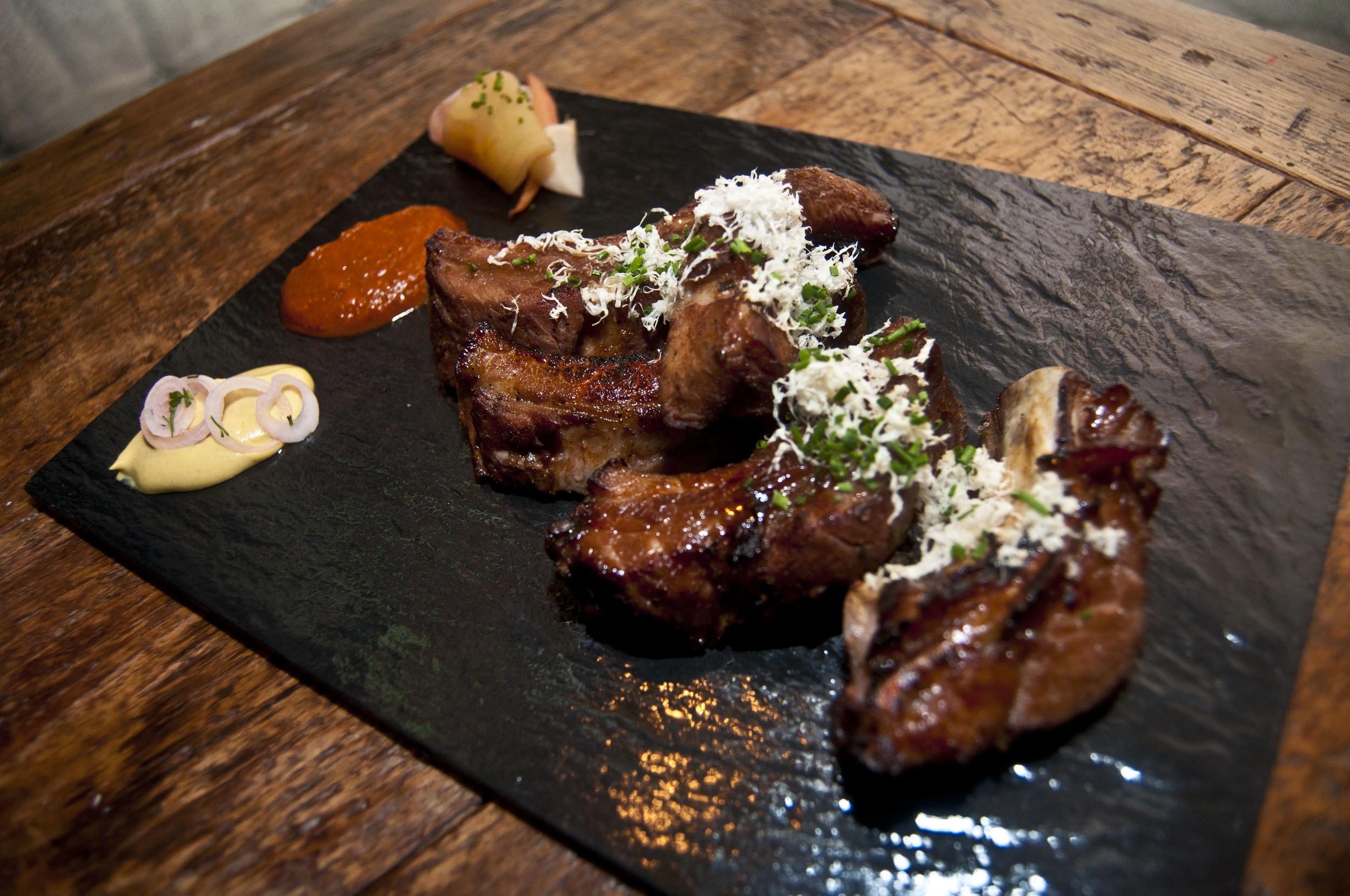
For a starter, we ordered the Baby-Back Ribs.  Served with smooth, spicy pretzel honey and a tomato/horseradish sauce, these pork ribs in no way resembled the sauce-laden, sinewy cuts of childhood summer picnics. Tender like stew meat, but without the imposed juice of a full braise, they fell off the bone with a full-bodied flavor that needed no sauce (though dip we did – that mustard was addictive!).

We then opted to share a main course of spätzle, daurade & wiener schnitzel, swapping plates and shifting tea lights, a manual lazy-susan of Austrian fare. The spätzle was topped with crisp arugula and fried onion shavings (so thin that I mistook them for cheese crisps). The dish included brussel sprouts, asparagus and wild mushrooms, which added a pleasant earthy flavor to this perfectly creamy (but not overly rich) pasta dish.

The daurade was a master class in fish cookery – pan-fried, moist, flaky fish in an almost crust-like encasing. Served over a mellow celery root puree and bitter broccoli rabe, the dish was dotted with – what I considered the star of the plate – a quintessential cluster of caramelized carrots (not too sweet and still al dente).

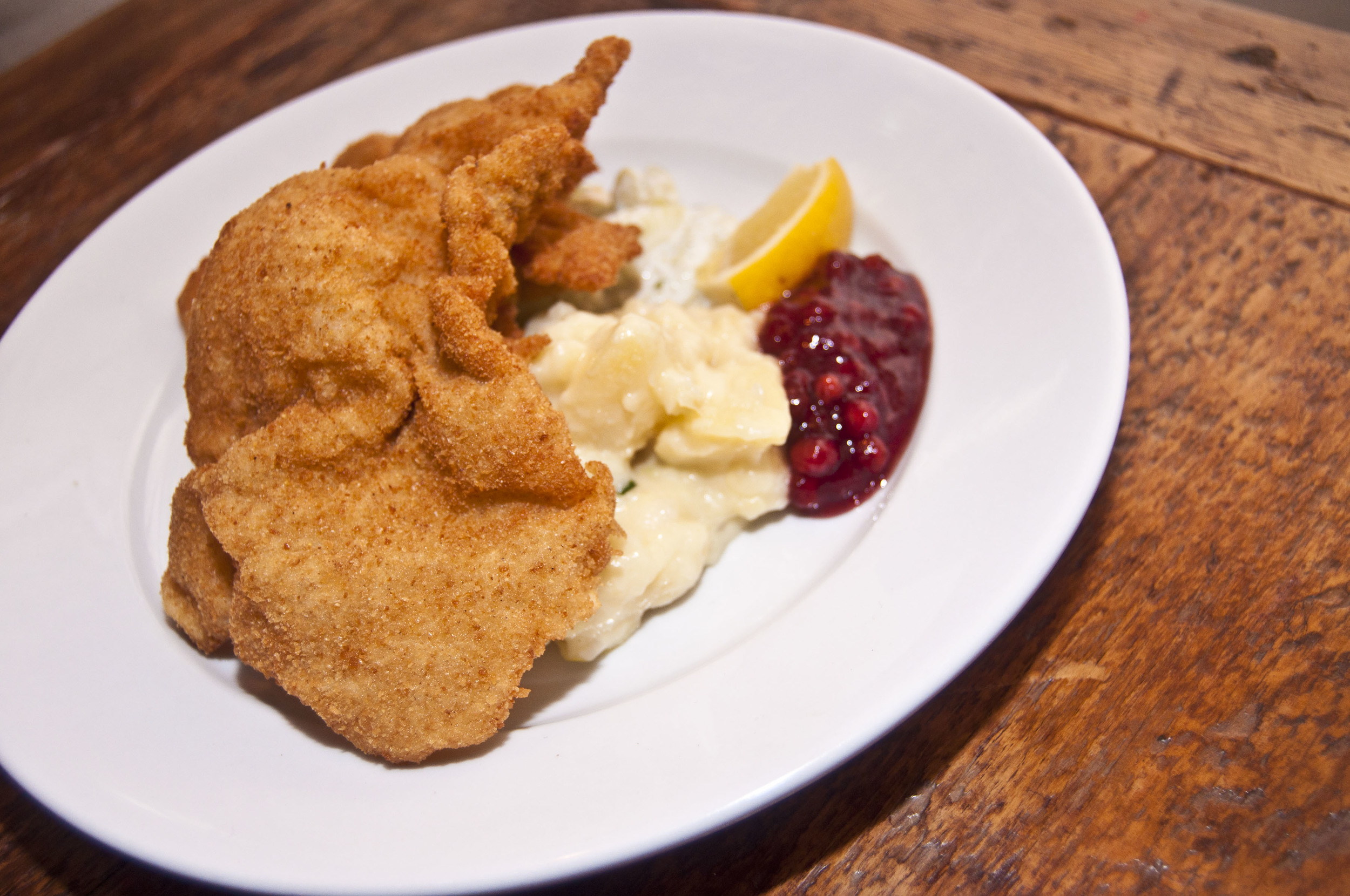
As for the wiener schnitzel, I know when to say I was wrong. Far from the dregs of the oil-sweating veal and breadcrumbs I encountered on that first fateful trip to Vienna, this veal was crisp and relatively light – so bereft of grease in fact, that (if it weren’t for the fat-infused flavor) one might guess it was baked. Furthermore, Edi’s schnitzel was the most balanced plate I can recall eating for some time. Cool cucumber and dill, tangy lingonberry jam married sweet, creamy and savory with the crunch of fried meat – accompanied by a smooth, slightly acidic potato salad, an unexpected, refreshing touch.

Chefs Eduard Frauneder and Wolfgang Ban have imbued even the heartiest Viennese recipes with a weightless elegance that will surprise both the schnitzel-savant and the new-Austrian-newbie.  The quality of the food is so good, in fact, that the exceptional romance and whimsy of Edi & the Wolf’s interior almost seems unnecessary, and thus, all the more delightful.

Edi & the Wolf 102 Avenue C, New York, NY (212) 598-1040

View the original article at HonestCooking.com.